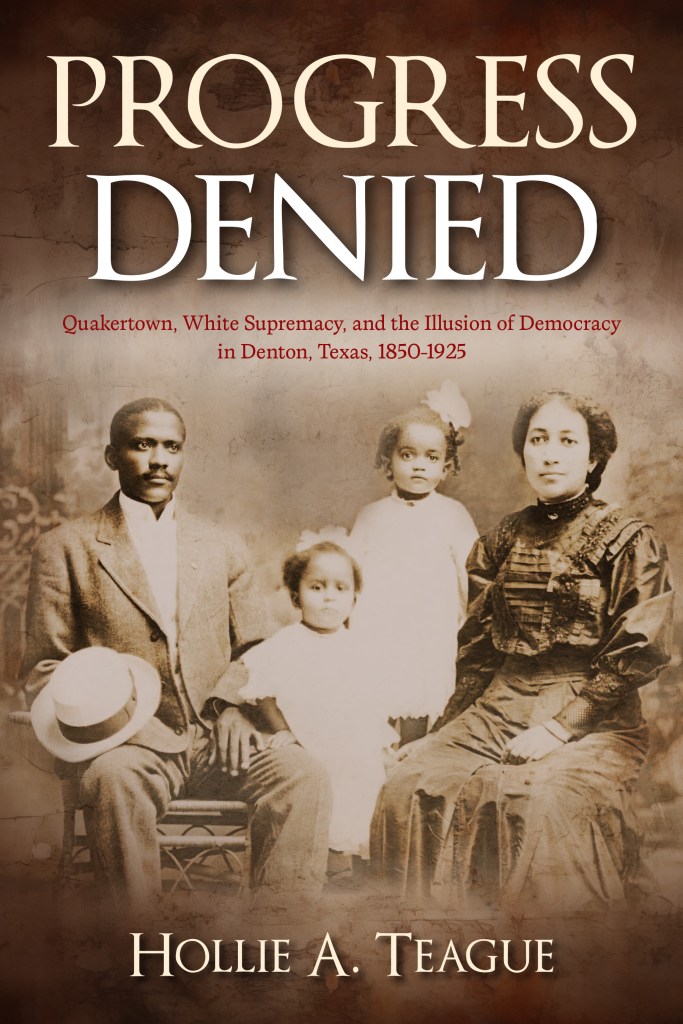
Sometimes, history isn’t what it appears to be. For instance, in the early 1920s, a thriving Southern black community was literally voted out of existence by local white supremacists. The north Texas city of Denton, which was sometimes described as a “Ku Klux Box,” was also home to the Quakertown neighborhood. There, black Texans worked hard to overcome the legacy of slavery, build financial success and family stability, educate their children, and worship God as they saw fit. And they did it all right in the middle of town. A model of “racial uplift” for over forty years, the community was eventually targeted by their white supremacist neighbors. Rather than using the torches and nooses often associated with the Jim Crow era, Denton’s white supremacists perpetrated a devastating act of “civic violence.” Cloaking themselves in the legitimacy associated with city government, institutions of higher learning, fraternal orders, and civic improvement groups, they were able to cover their tracks while they planned a large-scale racist dispossession. Then in 1920, they got access to the most destructive weapon they’d deploy – the vote for women. Quickly, white supremacists put the very existence of Quakertown on the (whites-only) ballot, disguised as a beautification measure. By a narrow margin, the black community was slated for destruction in 1921. Once the community removal was complete, Denton’s white supremacists used the language of democracy and majority rule to cover up the whole thing. This is the story of black success amidst the challenges of Jim Crow Texas, the way that white supremacists were able to manipulate democratic ideals to oppress their neighbors, and the legacy a deformed social memory left behind.
About the Author
New Book
Publications
Coming Soon (Works in Progress)
Connect / Contact
 Hollie A. Teague, PhD