Mary Anne Pember, Pantheon Books (2025) $29USD, 292 pp.
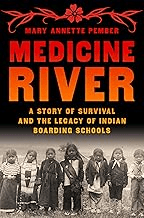
In this touching and informative book, journalist Mary Annette Pember beautifully weaves together 150 years of history with her own painful, insightful, and ultimately hopeful memoir. A quote by one of her interviewees – “powerlessness and low self-esteem are not part of our identity as Native people” (p. 229) – pretty much sums up Pember’s thesis, which she briskly proves in under 250 pages. Anyone who feels put off by the idea of reading history books will have no problems finishing this engaging work.
First introducing us to her mother Bernice through her child’s eye, Pember is able to easily establish the two main threads woven throughout the book: a personal reflection on her own family’s trauma/survival and a historical accounting of Indian Boarding Schools. The first photograph included in the book is of the author herself, four years old, the abused child of a mother with serious mental health challenges, crying in the corner of a room. But it isn’t too long until we learn that her mother was also once an abused and neglected “throwaway kid” who was deeply traumatized by her time in St. Mary’s Mission Indian Boarding School, also known as the Sisters’ School. Essentially abandoned there after violence tore her family apart, Bernice suffered both physical and mental abuse aimed at achieving the American government’s and Catholic Church’s shared goal of “killing the Indian and saving the man.”
Pember also introduces us to varied Native experiences through her brothers, grandmothers, aunts, and extended family, all of whom experienced the cultural trauma that impacted Ojibwe people and generations of other Native communities. However, she never uses her family as a pathway into telling the story of Indian Boarding Schools, or vice versa. Instead, the author simply and honestly demonstrates the inextricable relationship between the tremendous cultural violence of boarding schools and its legacy on families such as hers. Both strands are equally presented as important for present and future generations to understand.
Apologies, with varying degrees of sincerity, from the Canadian and American governments and the Catholic Church, are examined by Pember as part of the book’s ruminations on acknowledgement, forgiveness, and reconciliation. Again, she is able to explore those same themes in a more personal way when discussing her family relationships, fractures, wounds, and healing. Who apparently never received an apology or gave an apology was Pember’s mother Bernice. Rarely is an individual woman presented in scholarly historical work with as much care, understanding, and judgment, as well as psychological and historical insight, as Bernice Pember is in “Medicine River.” A truly complicated woman who inflicted seemingly-unforgivable damage on her children is presented through the loving lens of one of those children. As such, we are able to see that in fact Bernice, like all people, was deserving of forgiveness. Who is not is the perpetrators of a near-genocidal colonialism that destroyed Indian individuals and families for generations.
For educators, all or portions of Pember’s book will be useful in history or sociology classrooms focused on US History, Native American studies, race and identity, social stratification, family dynamics, or the (dys)functions of power. In writing or reading classrooms, professors will likely be able to use Pember’s work as an exemplar of insightful memoir, translating historical research for a popular audience, or meaningfully weaving together multiple stories and perspectives.
Anyone interested in the historical experiences of Native peoples in the US; the motivations and mechanisms of oppression used by the American government and the Catholic Church; the consequences of generational trauma; forgiveness and reconciliation; or simply gaining insights into one fascinating life story should read “Medicine River: The Story of Survival and the Legacy of Indian Boarding Schools.”
 Hollie A. Teague, PhD
Leave a comment